
Signs, Tokens & Covenants — Sovereign Discipline
Order: Sovereign Discipline
Tradition: Sikh tradition
Canon/Sources: Guru Granth Sahib, Sikh history, seva (selfless service), spiritual discipline
The Sovereign Discipline order draws its exemplars from the Sikh tradition: the Ten Gurus who carried the light from Guru Nanak to Guru Gobind Singh, and two devoted companions whose service became scripture-worthy. Every entry is grounded in real Sikh history and the Guru Granth Sahib. Where exact wording of a teaching is uncertain, it is paraphrased without quotation marks.

1. Guru Nanak Dev Ji
- Name of the Covenant: The Covenant of Oneness
- Description with Source Text: Guru Nanak Dev Ji (1469–1539) founded the Sikh faith after a profound spiritual experience at Sultanpur, following which Sikh tradition holds that he proclaimed there is no Hindu and no Muslim — all are children of the One. He journeyed for some twenty years across Asia on the udasis with his companion Bhai Mardana, teaching through hymns now enshrined in the Guru Granth Sahib, which opens with his declaration of the One divine reality, Ik Onkar.
- One Teaching: There is one divine reality behind all things; live by remembering the divine name, earning an honest living, and sharing what you have with others.
- Sign Hand Movement: Right hand raised to shoulder height, index finger pointing upward — the One above all divisions.
- Token Arm Movement and Body Movement: Both arms swept wide to the sides, then drawn slowly together to rest crossed over the heart — gathering all humanity into one embrace.
- Metaphysical Epiphany: Realizing that every boundary between peoples dissolves in the light of the One.
- The Proclamation: “I commit to see the One in all beings and all beings in the One.”
- Two or Three Witnesses: Bhai Mardana, who walked beside the Guru across every boundary of sect and land; Guru Gobind Singh Ji, who taught that the whole human race is to be recognized as one; Guru Amar Das Ji, who made equality a daily practice at the langar.
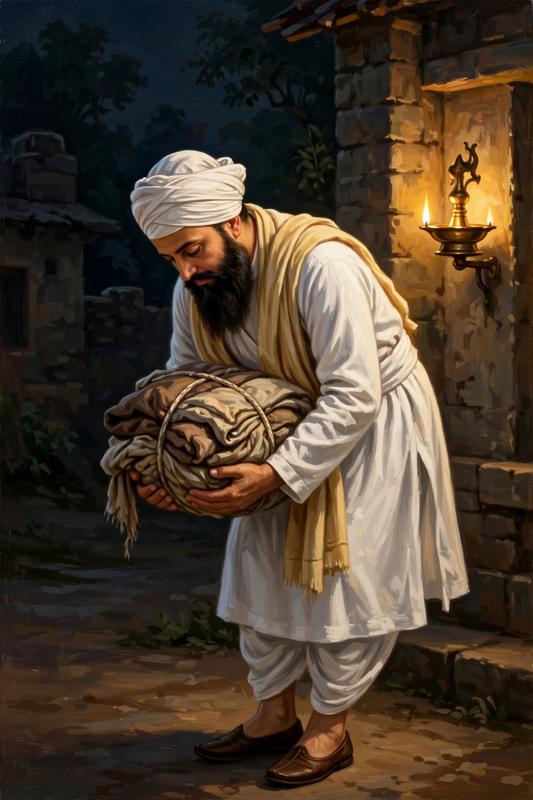
2. Guru Angad Dev Ji
- Name of the Covenant: The Covenant of Humble Discipleship
- Description with Source Text: Born Bhai Lehna, the second Guru (1539–1552) won Guru Nanak’s succession not by birth but by total devotion — Sikh tradition tells how he carried his master’s wet bundle of clothes without complaint through the night. As Guru he standardized the Gurmukhi script so ordinary people could read the hymns themselves, opened schools, and built wrestling arenas, teaching that a sound body serves a devoted soul. Sixty-two of his hymns are preserved in the Guru Granth Sahib.
- One Teaching: The highest place is earned by the humblest service; devotion, not birth or rank, decides who carries the light forward.
- Sign Hand Movement: Both hands cupped together low before the body, as one carrying a heavy bundle for another.
- Token Arm Movement and Body Movement: A slow, deep bow from the waist, arms sweeping downward toward the ground — lowering oneself in service.
- Metaphysical Epiphany: Realizing that true greatness is found in becoming small before the Master and the mission.
- The Proclamation: “I commit to serve before I lead, and to let devotion — not entitlement — speak for me.”
- Two or Three Witnesses: Mata Khivi, his wife, whose lifelong langar seva matched his own humility; Guru Ram Das Ji, who likewise served his Guru with complete devotion before being named successor; Bhai Mardana, the devoted companion who never sought rank.
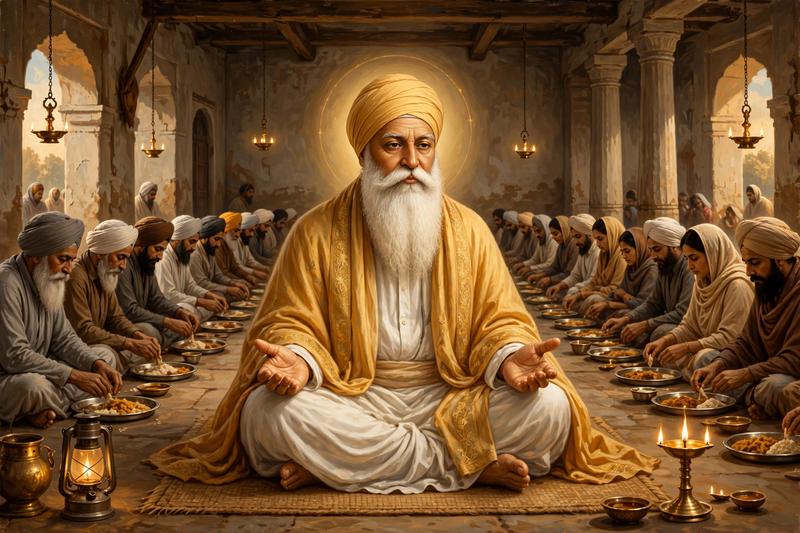
3. Guru Amar Das Ji
- Name of the Covenant: The Covenant of Equality
- Description with Source Text: The third Guru (1552–1574) became Guru at the age of seventy-three and made equality the law of his court: Sikh tradition holds that none could meet him without first sitting in the langar rows as an equal — first the shared meal, then the congregation. He abolished the burning of widows, opposed the veiling and seclusion of women, and appointed women among his missionary leaders. Over nine hundred of his hymns, including Anand Sahib, are preserved in the Guru Granth Sahib.
- One Teaching: No one stands above another before the Divine; let every person eat, sit, and be heard as your equal.
- Sign Hand Movement: Both hands held open, side by side at the same height, palms up — two lives leveled as one.
- Token Arm Movement and Body Movement: Sitting down cross-legged with arms sweeping outward to either side — taking one’s place in the unbroken row.
- Metaphysical Epiphany: Realizing that caste, rank, and custom are shadows, and only the equal soul is real.
- The Proclamation: “I commit to treat every person as my equal, at my table and in my dealings.”
- Two or Three Witnesses: Mata Khivi, who fed high and low from the same kitchen; Guru Nanak Dev Ji, who first declared women equal to men and caste an illusion; Guru Gobind Singh Ji, who raised the lowliest to the Khalsa’s vanguard.

4. Guru Ram Das Ji
- Name of the Covenant: The Covenant of the Loving Union
- Description with Source Text: The fourth Guru (1574–1581), born Bhai Jetha, founded the city of Ramdaspur — the Amritsar of today — around the pool of nectar he had excavated. In the Guru Granth Sahib he composed the four Lavaan, the wedding hymns in which the human soul is the bride circling toward union with the Divine Beloved; they are sung at every Sikh marriage to this day.
- One Teaching: The soul’s journey is a marriage: walk your life in steady circles around the Divine Beloved until the two are one.
- Sign Hand Movement: Both hands brought together, fingers interlaced — two lives woven into one.
- Token Arm Movement and Body Movement: Four slow steps taken in a circle around an imagined center, hands folded — the soul’s circling toward the Beloved.
- Metaphysical Epiphany: Realizing that all human love is a rehearsal for the soul’s union with the Divine.
- The Proclamation: “I commit to walk each day as a step in the circling path toward the Beloved.”
- Two or Three Witnesses: Guru Arjan Dev Ji, his son, who built the Golden Temple at the heart of the city his father founded; Guru Nanak Dev Ji, who established the first Sikh community at Kartarpur; Bhai Gurdas, the devoted scholar-poet whose verses expound the Guru’s teachings.
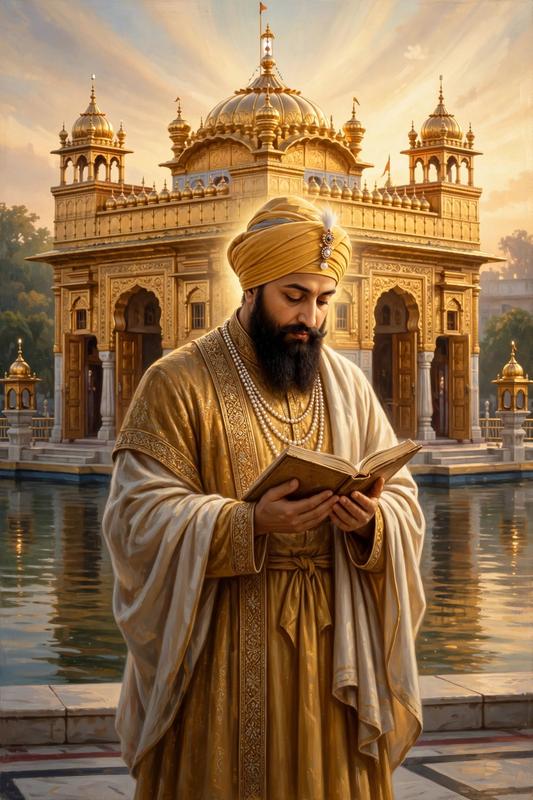
5. Guru Arjan Dev Ji
- Name of the Covenant: The Covenant of the Living Word
- Description with Source Text: The fifth Guru (1581–1606) gathered the hymns of the earlier Gurus and the saint-poets into the Adi Granth, installed in 1604 at the Harmandir Sahib — the Golden Temple he completed with four doors open to all four directions of humanity. His own vast compositions, including the Sukhmani Sahib, the Psalm of Peace, fill the Guru Granth Sahib. Arrested under Emperor Jahangir’s orders, he was tortured to death at Lahore in 1606, accepting it all as the divine will, and became the first Sikh martyr.
- One Teaching: Enshrine the Word and let it outlive you; the scripture gathered in truth becomes the Guru that never dies.
- Sign Hand Movement: Both hands held open before the chest, as if holding a book — receiving the Word.
- Token Arm Movement and Body Movement: Bowing the head low toward the open hands — laying the self before the scripture.
- Metaphysical Epiphany: Realizing that the Word written in devotion outlives every hand that writes it and every power that burns it.
- The Proclamation: “I commit to let the sacred Word dwell in me and order my days.”
- Two or Three Witnesses: Bhai Gurdas, who served as the scribe when the Adi Granth was compiled; Guru Angad Dev Ji, who preserved the hymns and gave them their script; Guru Gobind Singh Ji, who gave the scripture its final form and declared it the eternal Guru.

6. Guru Hargobind Ji
- Name of the Covenant: The Covenant of Miri-Piri
- Description with Source Text: The sixth Guru (1606–1644) took up the Guruship as a boy after his father’s martyrdom and girded himself with two swords, proclaiming Miri-Piri — the sovereignty of the saint and the soldier together. He raised the Akal Takht as the throne of temporal justice facing the Golden Temple, and Sikh tradition holds that when released from Gwalior Fort he refused freedom unless fifty-two captive princes walked out with him — the liberation still celebrated as Bandi Chhor Divas.
- One Teaching: Be a saint in spirit and a soldier in duty: meditation and the sword are the two edges of one sovereignty, wielded to protect the innocent.
- Sign Hand Movement: Both forearms raised vertically side by side before the chest, hands firm and open — the two swords standing as one resolve.
- Token Arm Movement and Body Movement: Feet planted wide, both arms raised straight overhead, then lowered to rest crossed over the chest — vigilance gathered into the heart.
- Metaphysical Epiphany: Realizing that peace is a garden that must sometimes be guarded, and the guardian’s strength is itself a form of prayer.
- The Proclamation: “I commit to be gentle in spirit and fearless in defense of the innocent.”
- Two or Three Witnesses: Guru Gobind Singh Ji, who fulfilled the saint-soldier ideal in the Khalsa; Guru Tegh Bahadur Ji, who spent his life for others’ freedom; Baba Deep Singh, who gave his life defending the Golden Temple.
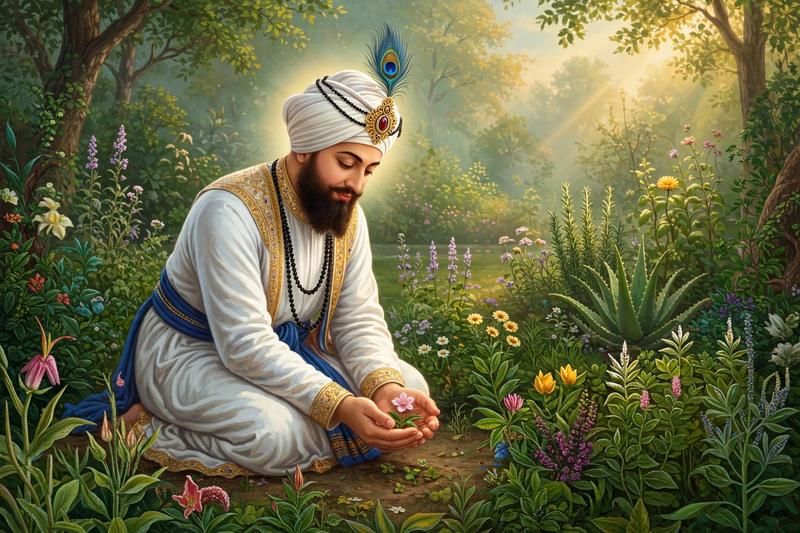
7. Guru Har Rai Ji
- Name of the Covenant: The Covenant of Gentleness
- Description with Source Text: The seventh Guru (1644–1661), who received the Guruship as a young teenager, was renowned for a tenderness that extended to every living creature — he would not break even a flower needlessly. He kept gardens of healing herbs and a dispensary where medicine was given freely to all who came, and Sikh tradition remembers him treating all sufferers without distinction of friend or foe.
- One Teaching: Let your strength be measured by your gentleness; heal whoever comes to you and harm no living thing willingly.
- Sign Hand Movement: One hand extended, palm down, fingers softly curved — sheltering something small and fragile beneath it.
- Token Arm Movement and Body Movement: Kneeling slowly with both hands cupped near the ground, as one tending a young plant — care made bodily.
- Metaphysical Epiphany: Realizing that the mightiest sovereignty is the one that kneels to lift the fallen.
- The Proclamation: “I commit to heal where I can and to harm nothing willingly.”
- Two or Three Witnesses: Guru Harkrishan Ji, his son, who served plague victims with his own hands; Bhai Kanhaiya, who gave water to the wounded of both armies; Mata Khivi, whose kitchen nourished every body that came.
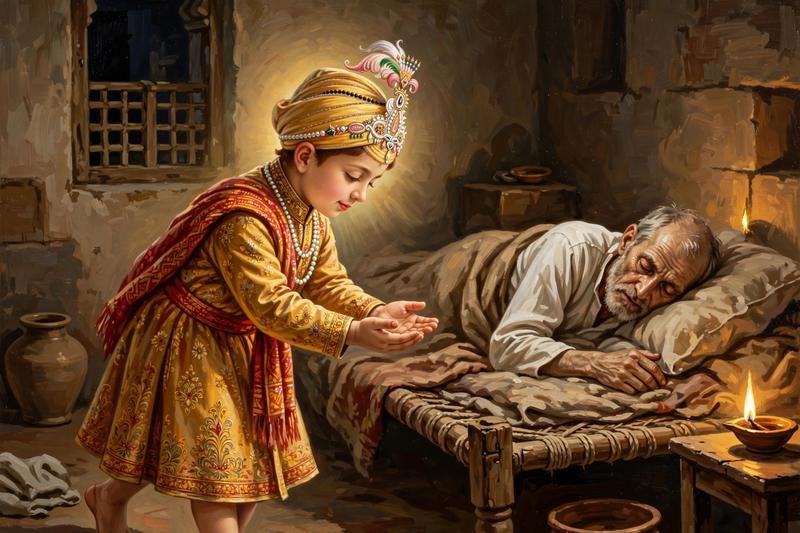
8. Guru Harkrishan Ji
- Name of the Covenant: The Covenant of the Healer
- Description with Source Text: The eighth Guru (1661–1664) was named Guru at the age of five and is remembered above all for his compassion during a smallpox epidemic in Delhi: he went among the sufferers, serving and comforting them, until he himself was stricken and died at the age of eight. Sikh tradition honors him as the child Guru whose brief life was pure seva.
- One Teaching: Serve the suffering without counting the cost; love does not calculate what giving will take from the giver.
- Sign Hand Movement: Right hand placed over the heart, then extended outward toward another — the heart’s compassion sent forth.
- Token Arm Movement and Body Movement: Stepping forward and bowing the head while extending both hands forward, palms up — offering oneself to the need before you.
- Metaphysical Epiphany: Realizing that the measure of a life is not its length but the depth of its giving.
- The Proclamation: “I commit to serve the suffering without counting the cost.”
- Two or Three Witnesses: Guru Har Rai Ji, his father, whose gentleness he embodied; Bhai Kanhaiya, who tended the wounded without distinction; Mata Khivi, who fed the hungry as her life’s work.
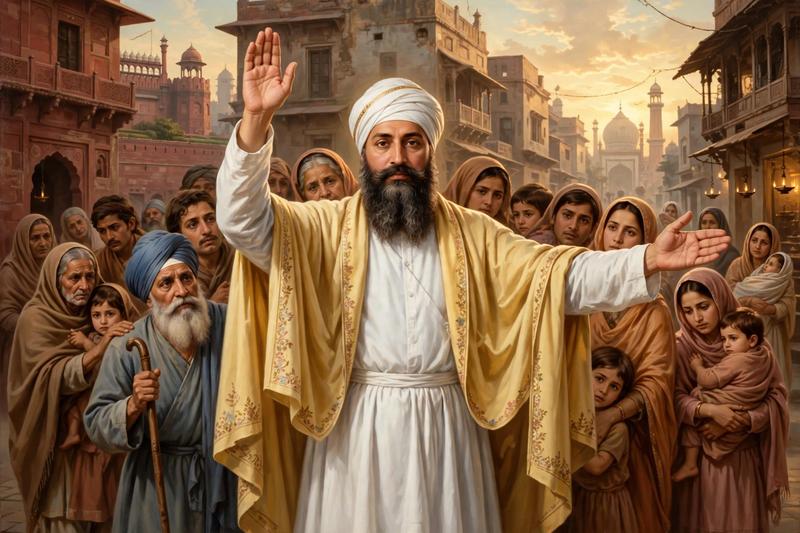
9. Guru Tegh Bahadur Ji
- Name of the Covenant: The Covenant of the Shield
- Description with Source Text: The ninth Guru (1665–1675) gave his life not for his own community but for another’s: when Kashmiri Pandits faced forced conversion under Emperor Aurangzeb, he stood surety for their freedom of conscience and was beheaded at Chandni Chowk, Delhi, in November 1675, after watching his companions martyred before his eyes. Revered as the Shield of India, his 115 hymns in the Guru Granth Sahib teach detachment from both pleasure and fear.
- One Teaching: Defend every person’s right to their own conscience, even at the cost of your life; freedom guarded only for oneself is not freedom.
- Sign Hand Movement: Right forearm raised vertically before the body, hand firm — a shield set between the oppressor and the oppressed.
- Token Arm Movement and Body Movement: Stepping forward, planting the feet, and spreading both arms wide — the body itself becoming a wall for the vulnerable.
- Metaphysical Epiphany: Realizing that the highest courage is to die for a stranger’s freedom, and that such a death cannot be defeated.
- The Proclamation: “I commit to stand between the persecutor and the persecuted, whatever it costs me.”
- Two or Three Witnesses: Guru Arjan Dev Ji, the first martyr, who accepted torture as the divine will; Guru Hargobind Ji, his father, who forged the saint-soldier’s duty to protect; Guru Gobind Singh Ji, his son, who turned that sacrifice into the Khalsa’s founding fire.
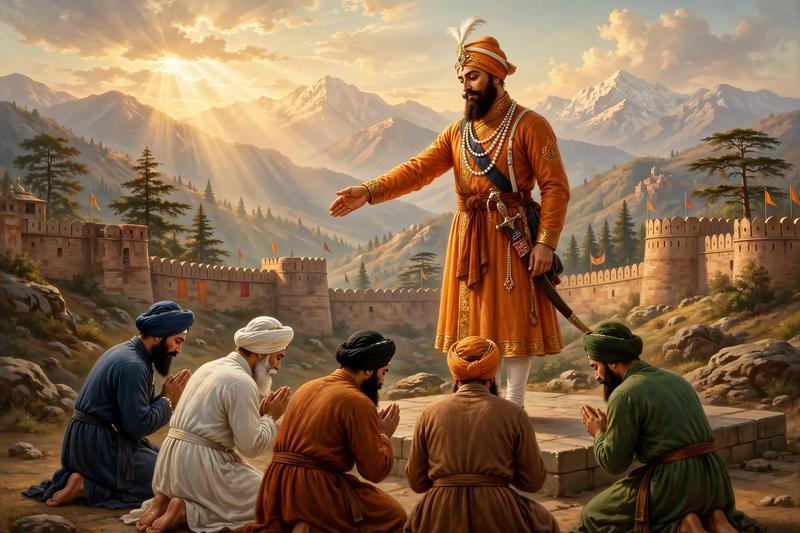
10. Guru Gobind Singh Ji
- Name of the Covenant: The Covenant of the Khalsa
- Description with Source Text: The tenth Guru (1675–1708) transformed the community on Vaisakhi 1699 at Anandpur, calling for heads and initiating the Panj Pyare — the Five Beloved Ones — as the first of the Khalsa, the order of the pure, marked by the Five Ks and a code of fearless, disciplined living. He taught that the whole human race is to be recognized as one, and before his passing in 1708 he ended the line of human Gurus, declaring the Guru Granth Sahib the eternal living Guru.
- One Teaching: Stand recognizable: let your life be pure, your conduct disciplined, and your courage complete — and know all humanity as one family.
- Sign Hand Movement: Right fist pressed firmly over the heart — the vow sealed within.
- Token Arm Movement and Body Movement: Standing tall, the right arm raised and swept in a single decisive arc from left to right — the resolve of one who has answered the call.
- Metaphysical Epiphany: Realizing that identity is a vow worn on the body, and that a community bound by such vows cannot be broken.
- The Proclamation: “I commit to stand recognizable — pure in conduct, disciplined in life, fearless in truth.”
- Two or Three Witnesses: The Panj Pyare, who answered the call for heads and became the Khalsa’s foundation; Guru Hargobind Ji, who first joined the saint to the soldier; Guru Tegh Bahadur Ji, whose martyrdom lit the fire the Khalsa carries.
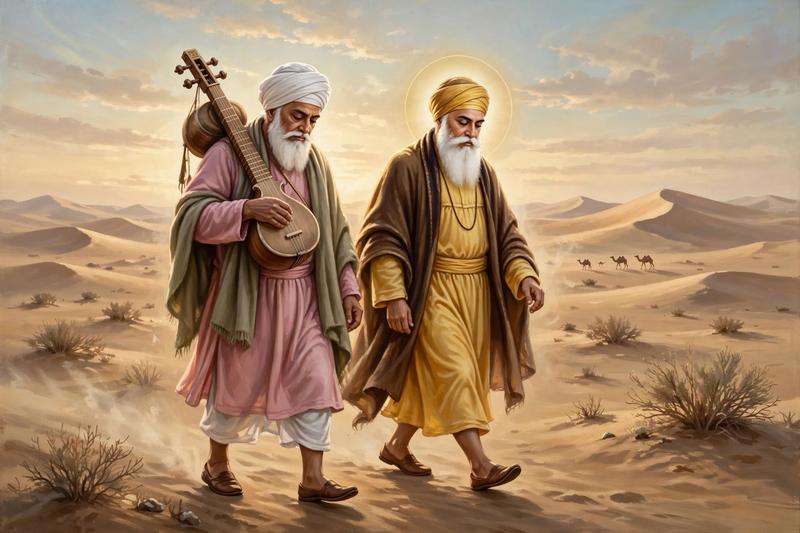
11. Bhai Mardana
- Name of the Covenant: The Covenant of Faithful Companionship
- Description with Source Text: Bhai Mardana (1459–1534), a Muslim-born hereditary minstrel of Talwandi, was Guru Nanak’s boyhood friend and lifelong companion, playing the rabab while the Guru sang the divine word across the udasis — journeys that reached as far as Mecca and beyond. Sikh tradition records that he stayed beside the Guru for decades, and verses preserved under his name appear in the Guru Granth Sahib, honoring the companion who carried the music of the mission.
- One Teaching: Devotion needs no pedigree: walk faithfully beside the bearer of truth, and let your own gift — whatever it is — serve the song.
- Sign Hand Movement: Both hands held at the left shoulder as if cradling a stringed instrument — the minstrel’s posture of service.
- Token Arm Movement and Body Movement: Three slow steps forward with the head slightly bowed — the fellow-traveler keeping pace with the Master.
- Metaphysical Epiphany: Realizing that the humblest companion may carry the holiest tune, and that loyalty is itself a form of worship.
- The Proclamation: “I commit to walk faithfully beside those who carry the truth, whatever road they take.”
- Two or Three Witnesses: Guru Nanak Dev Ji, whom he accompanied for a lifetime; Guru Angad Dev Ji, the disciple whose devotion likewise knew no rank; the Panj Pyare, who answered the Guru’s call and never left his side.
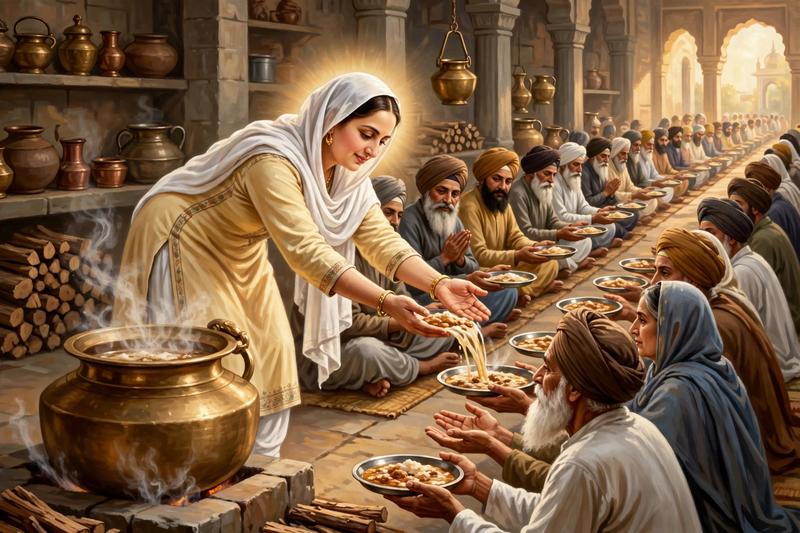
12. Mata Khivi
- Name of the Covenant: The Covenant of the Open Kitchen
- Description with Source Text: Mata Khivi (1506–1582), wife of Guru Angad Dev Ji, devoted her life to the langar, the free kitchen where all ate as equals — and the Guru Granth Sahib itself, in the Ramkali composition of Satta and Balwand, celebrates her generous hospitality as a spiritual attainment. She served through the time of the first Gurus, and Sikh tradition holds her the mother of the langar, the exemplar of seva that asks nothing of those it feeds.
- One Teaching: Feed whoever comes to your door, asking nothing of them first; the kitchen that serves all equally is a temple.
- Sign Hand Movement: Both hands extended forward together, palms up — the eternal offering of food.
- Token Arm Movement and Body Movement: Bending slightly forward with arms extended in offering — the server’s bow, given gladly and without end.
- Metaphysical Epiphany: Realizing that feeding the hungry is feeding the Divine hidden within them, and that no seva is small.
- The Proclamation: “I commit to feed whoever comes to my door, asking nothing of them first.”
- Two or Three Witnesses: Guru Angad Dev Ji, her husband, whose mission her kitchen sustained; Guru Amar Das Ji, who made her langar the gateway to the Guru; Guru Nanak Dev Ji, who spent his trade-money feeding the hungry and called it the true bargain.
Written for the Sovereign Discipline order of the Free Assembly. Teachings are paraphrased from Sikh history and the Guru Granth Sahib; no scriptural wording is quoted. Movements are designed to be simple, dignified, and reverent.